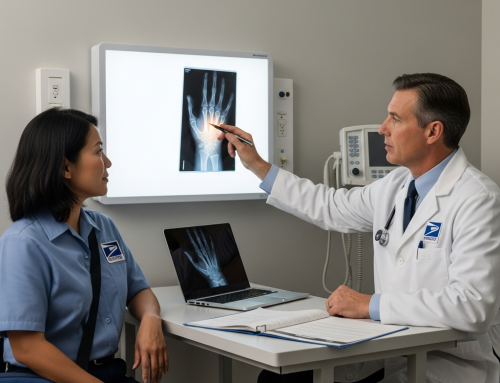
You’re sitting at your desk in the federal building, and that nagging pain in your lower back – the one you’ve been ignoring for months – suddenly shoots down your leg like lightning. Or maybe you’re walking to the courthouse when you slip on those eternally wet marble steps and feel your wrist crack against the railing. Could be that repetitive strain in your shoulders from hunching over case files has finally reached the point where you can’t lift your coffee cup without wincing.
Sound familiar? If you’re nodding along, you’re definitely not alone.
Here’s the thing about working for the federal government in the Bronx – whether you’re processing claims at Social Security, handling cases at the courthouse, working at the VA hospital, or managing operations at any of the dozens of federal facilities scattered throughout the borough – your job comes with risks. Some are obvious, like the security officer who gets injured restraining someone. Others are sneaky, building up over years until one day your body just says “enough.”
And when that moment hits? When you’re hurt and wondering how you’ll pay for treatment while potentially missing work? That’s when you need to understand your rights under the Federal Employees’ Compensation Act – or FECA, as it’s known in government circles.
Now, I know what you’re thinking. Workers’ compensation sounds about as exciting as watching paint dry, and nearly as confusing as trying to navigate the subway system during rush hour. But here’s the reality – if you’re a federal employee in the Bronx and you get injured on the job, understanding FECA could literally be the difference between financial security and… well, let’s just say you don’t want to find out what the alternative looks like.
Why This Matters More Than You Think
The Bronx has one of the highest concentrations of federal workers in New York State. We’re talking thousands of people – from the Social Security Administration offices on the Grand Concourse to the federal courthouse on Bruckner Boulevard, from the VA Medical Center to the various HUD and immigration facilities. That’s a lot of people who could potentially need workers’ compensation, and unfortunately, a lot of people who don’t realize what they’re entitled to until it’s too late.
See, FECA isn’t like regular workers’ compensation. It’s… different. Sometimes better, sometimes more complicated, always federally regulated. And if you don’t know how to navigate the system – or worse, if you don’t even know you qualify – you could be missing out on benefits that could cover everything from your medical bills to wage replacement to vocational rehabilitation.
I’ve seen federal employees struggle through injuries they thought weren’t “serious enough” to file a claim, only to discover months later that their condition had worsened and they’d missed critical deadlines. I’ve watched people return to work too early because they didn’t understand their rights to time off. And don’t get me started on the folks who tried to handle everything themselves and ended up with denied claims that could have been approved with the right approach.
What You’re About to Learn
Throughout this guide, we’re going to walk through everything you need to know about FECA benefits as a federal worker in the Bronx. We’ll talk about who qualifies (spoiler: probably more people than you’d expect), what types of injuries and illnesses are covered, and how the whole process actually works from start to finish.
You’ll learn about the specific deadlines you absolutely cannot miss, the paperwork that actually matters (and the stuff you can skip), and how to work with the medical providers in the Bronx area who understand the federal system. We’ll also cover what to do if your claim gets denied – because unfortunately, that happens more often than it should.
Most importantly, we’ll help you understand when you should handle things yourself versus when you need professional help. Because while I’m all for DIY projects, your workers’ compensation claim probably isn’t the place to wing it.
Whether you’re dealing with a fresh injury, managing an ongoing condition, or just want to understand your rights before something happens… well, you’re in the right place. Let’s make sure you get every benefit you’re entitled to.
What Federal Workers Comp Actually Covers (And What It Doesn’t)
Think of federal workers’ compensation like a really specific insurance policy – one that only kicks in when you get hurt *because* of your job. Not hurt *while* at your job (there’s a difference, trust me), but actually because of what you were doing for Uncle Sam.
Here’s where it gets a bit… well, bureaucratic. The Federal Employees’ Compensation Act – or FECA, because government loves acronyms – covers you if you’re a federal employee who gets injured or develops an illness that’s directly related to your work. Sounds straightforward, right?
Actually, it’s more like trying to prove your toddler broke the lamp. You need evidence, witnesses, and a really good explanation of exactly how it happened.
The “Performance of Duty” Puzzle
This phrase gets thrown around a lot, and honestly? It confuses people all the time. “Performance of duty” doesn’t just mean you were clocked in when something went wrong. It means you were actively doing something your job required – or something reasonably connected to your job.
Let me paint you a picture. Say you’re a postal worker in the Bronx, and you slip on ice while delivering mail. That’s performance of duty. But if you slip on that same ice while walking to the corner deli for lunch? That’s… probably not going to fly.
The tricky part is all the gray areas. What if you’re helping a coworker move boxes that aren’t technically your responsibility? What if you’re walking to a work meeting but haven’t officially started yet? These situations happen all the time, and honestly, they’re decided case by case.
Types of Injuries That Count (And Some That Don’t)
FECA covers both sudden injuries – like breaking your wrist in a fall – and occupational diseases that develop over time. Carpal tunnel from years of typing? Hearing loss from working around loud machinery? Back problems from lifting heavy packages? These can all qualify.
But here’s where it gets counterintuitive… emotional or psychiatric conditions are harder to prove, though not impossible. You’d need to show that work stress or a traumatic workplace incident directly caused your condition. It’s not enough to say your job is stressful (whose isn’t?), but if you witnessed a serious accident at work and developed PTSD, that could qualify.
One thing that surprises people – pre-existing conditions don’t automatically disqualify you. If your job makes an existing back problem worse, you might still have a claim. Think of it like this: if you have a small crack in a window and someone throws a ball at it, the ball thrower is still responsible for the broken window.
The Documentation Dance
Here’s something nobody warns you about – federal workers’ comp lives and dies by paperwork. And I mean *lives and dies*. You could have the most legitimate injury in the world, but if you don’t document it properly, you’re going to have problems.
First, you need to report your injury to your supervisor right away. “Right away” officially means within 30 days, but honestly? Don’t wait. The longer you wait, the more questions people ask. It’s like trying to explain why you didn’t mention that weird noise your car was making until it completely broke down.
Then comes Form CA-1 (for sudden injuries) or CA-2 (for occupational diseases). Your supervisor needs to fill out their part, you fill out yours, and your doctor – if you’ve seen one – fills out theirs. It’s like a relay race, except if anyone drops the baton, you start over.
Medical Treatment – The Good and the Confusing
Once your claim is accepted (and that’s a whole other conversation), FECA pays for all necessary medical treatment related to your injury. No copays, no deductibles, no arguing with insurance companies about whether that MRI was really necessary.
But – and this is important – you can’t just go to any doctor. Well, you can for the first 30 days after your injury, but after that, you need to choose from a list of authorized physicians. It’s like having a really good health plan with a very specific network.
The system also covers vocational rehabilitation if you can’t return to your old job. They’ll help retrain you for something else within the federal government. Actually, that reminds me of a client who went from being a mail carrier to working in an office role after a back injury – sometimes these transitions work out better than expected.
Why Location Matters (Yes, Even in the Bronx)
You might wonder why we’re talking specifically about the Bronx when federal workers’ comp is… well, federal. The rules are the same whether you work in Manhattan or Montana. But practically speaking, where you are absolutely matters for things like finding authorized doctors, getting to medical appointments, and understanding local resources that can help you navigate the system.
Start with the Paperwork Trail – It’s Your Best Friend
Here’s something most people don’t realize: federal workers comp cases live or die on documentation. I’m talking about creating a paper trail that’s so detailed, it practically tells your story for you.
First thing Monday morning? Get to your supervisor and file Form CA-1 (for traumatic injuries) or CA-2 (for occupational diseases) within 30 days of your injury or when you first noticed symptoms. Don’t wait because you’re “not sure if it’s serious enough” – that thinking has cost more people their benefits than you’d believe.
But here’s the insider tip… before you even submit those forms, make copies of everything. And I mean everything – your medical records, witness statements, even that email where your coworker mentioned they saw you fall. Store one copy at home, give one to a trusted family member, and keep the originals for submission.
The Medical Provider Maze (And How to Navigate It)
This is where things get tricky – and expensive if you’re not careful. You can’t just waltz into any doctor’s office expecting OWCP to pick up the tab.
Your doctor needs to be on the approved list, or you’ll need prior authorization from OWCP. Start by calling the OWCP nurse assigned to your case (yes, you’ll get one) and ask for their recommended providers in your area. They know which doctors are familiar with federal workers comp procedures… and trust me, that familiarity makes a huge difference in getting your claim approved.
Actually, that reminds me of something crucial – when you do see the doctor, don’t downplay your symptoms. I get it, we’re conditioned to be tough, especially in federal work environments. But this isn’t the time for heroics. Be honest about your pain levels, limitations, and how the injury affects your daily life. That medical report becomes the foundation of your entire case.
The Return-to-Work Chess Game
Here’s where strategy really matters. OWCP will eventually push for you to return to work – it’s just how the system works. But you have more control over this timeline than most people realize.
If your doctor says you can return to “light duty,” work with your supervisor to define exactly what that means. Get it in writing. Can you lift 10 pounds? 20? Do you need frequent breaks? Can you stand for extended periods? Vague restrictions lead to re-injury… and starting this whole process over again.
The secret sauce? Request a fitness-for-duty examination through OWCP if there’s any question about your ability to perform your job safely. Yes, it adds time to the process, but it also protects you from being pushed back too quickly.
Understanding Your Benefits Package
Let’s talk money – because bills don’t stop coming while you’re healing. You’re entitled to wage replacement benefits, typically around 66-75% of your salary depending on your situation (higher percentage if you have dependents).
But here’s what they don’t tell you upfront: you might be eligible for schedule awards if you have permanent partial disability. We’re talking about compensation for things like reduced range of motion in a shoulder or permanent hearing loss. Even if it seems minor, get it evaluated. I’ve seen people leave thousands on the table because they assumed their injury “wasn’t that bad.”
When Things Go Sideways
Sometimes claims get denied. It happens more than it should, honestly. But denial isn’t the end of the story – it’s just the beginning of round two.
You have 30 days to request a hearing before an OWCP hearing representative. Don’t try to go it alone here. Contact the Department of Labor’s Office of Workers’ Compensation Programs and ask about getting a hearing representative assigned to your case.
The appeals process can feel overwhelming, but here’s your advantage: most denials happen because of incomplete medical evidence or unclear causal relationships between your work and injury. A good hearing rep knows exactly what documentation OWCP wants to see.
Your Secret Weapon: The OWCP Nurse
This might be the most underutilized resource in the entire system. That nurse assigned to your case? They’re not just there to check boxes – they can be your advocate if you work with them properly.
Call them regularly with questions. They know which doctors have good relationships with OWCP, which medical tests might strengthen your case, and how to navigate the bureaucratic maze. Building a good relationship with your nurse can literally make or break your claim.
Remember, this isn’t about gaming the system – it’s about understanding how to work within it effectively when you’re legitimately injured on the job.
The Paperwork Maze That Actually Trips Everyone Up
Let’s be real – the forms are brutal. You’re dealing with pain, stress about work, and then they hand you a stack of paperwork that looks like it was designed by someone who’s never actually filled out a form in their life.
The CA-1 (for sudden injuries) and CA-2 (for occupational diseases) are where most people stumble. Here’s what actually helps: don’t try to be Shakespeare. Be specific, but simple. Instead of “I hurt my back,” write “I felt sharp pain in my lower back when lifting a 40-pound box from floor to shelf height.” The difference? One tells a story they can follow – and more importantly, one they can approve.
Pro tip that no one tells you: Get a copy of everything before you submit it. Seriously. Forms get “lost” more often than you’d think, and starting over from scratch when you’re already hurt? That’s just adding insult to actual injury.
When Your Supervisor Becomes… Less Than Supportive
This is the part that really stings. You’ve worked alongside these people for years, maybe even considered them friends. Then you get hurt on the job and suddenly there’s this weird tension. Some supervisors get genuinely uncomfortable – they don’t know what to say or how to help. Others, unfortunately, start seeing you as a liability.
You might notice subtle (or not-so-subtle) pressure to downplay your injury. Comments like “Are you sure it’s that serious?” or “Maybe you just need a day or two off?” These aren’t necessarily coming from a bad place – often supervisors are worried about their own metrics and departmental budgets.
Here’s what actually works: document everything. Not in a paranoid way, but in a “protecting yourself” way. Send follow-up emails after verbal conversations. “Hi Sarah, just confirming our conversation about my injury report. As we discussed, I’ll be seeing the doctor tomorrow and will update you on any work restrictions.”
The Medical Runaround (And How to Navigate It)
Federal workers comp has its own special brand of medical bureaucracy. You can’t just see any doctor – you need to see an approved physician, and sometimes that means waiting longer than you’d like or traveling further than is convenient.
But here’s something that might surprise you: you actually have more control than you think. You can request a specific doctor from the approved list. Do your homework – look up reviews, ask around, find someone who understands occupational injuries. A doctor who specializes in workplace injuries will know exactly what language to use in their reports to help your case.
The other thing that trips people up? Those independent medical examinations (IMEs). These can feel adversarial – because, well, sometimes they are. The doctor isn’t “your” doctor; they’re there to provide an objective assessment. Go in prepared. Bring all your medical records, be honest about your limitations, but don’t minimize your symptoms either.
When Benefits Get Delayed or Denied
This is where a lot of people panic – and honestly, who wouldn’t? You’re not getting paid, medical bills are piling up, and you’re starting to wonder if you made the right choice filing a claim at all.
First, take a breath. Delays are ridiculously common, especially for complex cases or when additional medical evidence is needed. It doesn’t necessarily mean your claim is in trouble.
If you get a denial letter, don’t just accept it. Most initial denials are overturned on appeal – but you have to actually file that appeal. You’ve got 30 days from the date on the letter, and this isn’t the time to procrastinate.
This is probably when you want to talk to someone who knows the system. Whether that’s a workers’ comp attorney or a patient advocate, having someone who speaks “federal bureaucracy” can make all the difference. They know which forms to file, what evidence matters most, and how to present your case in a way that makes sense to the people making decisions.
The Emotional Toll Nobody Talks About
Here’s something they don’t put in the brochures: dealing with a work injury while navigating federal workers comp can be emotionally exhausting. You’re dealing with physical pain, financial stress, and often a system that feels like it’s working against you rather than for you.
It’s normal to feel frustrated, anxious, or even angry. You’re not being dramatic – you’re being human. Don’t be afraid to ask for help, whether that’s from family, friends, or a counselor who understands workplace injuries.
Remember, you earned these benefits. You’re not asking for charity – you’re claiming something you’ve already paid into through your years of federal service.
What to Expect After Filing Your Claim
Look, I’m going to be straight with you – this isn’t going to happen overnight. Federal workers’ compensation claims move at their own pace, and that pace is… well, let’s just say it’s thorough rather than speedy. You’re looking at anywhere from 45 days to several months for an initial decision, depending on how complex your situation is.
The good news? This gives you time to focus on what really matters – your health and recovery. And honestly, that’s exactly what you should be doing right now.
Once you submit your CA-1 or CA-2 form (remember, CA-1 for sudden injuries, CA-2 for occupational diseases that developed over time), the Office of Workers’ Compensation Programs takes over. They’ll review your medical evidence, check with your employing agency, maybe request additional documentation. It’s like a very methodical detective story – they want to make sure all the pieces fit together.
Don’t panic if they ask for more information. Actually, that’s pretty normal. Sometimes they need clarification about your job duties, or they want to see additional medical records. Think of it as them being thorough, not suspicious.
Managing Your Medical Care During the Process
Here’s something that trips up a lot of people – you can’t just see any doctor you want. Well, you can initially, but if you want OWCP to cover the costs, you need to follow their rules. For the first 30 days after your injury, you can see any physician. After that? You’ll need to choose from OWCP’s approved provider list.
This is where things get a bit… interesting. The approved provider network isn’t always as robust as we’d like, especially in certain specialties. You might find yourself traveling a bit further for appointments than you’d prefer. It’s frustrating, I know, but planning for this reality upfront can save you stress later.
And here’s a tip from someone who’s seen this process countless times – keep every receipt, every appointment note, every piece of paper related to your medical care. I mean everything. That parking receipt from your doctor’s visit? Keep it. OWCP can reimburse reasonable travel expenses, but only if you can document them.
Your Income While You Wait
Let’s talk about the elephant in the room – money. If you’re completely unable to work, you might be eligible for compensation payments while your claim is being processed. But (and this is a big but) these payments typically don’t start immediately.
For the first three days after your injury, you’ll usually need to use your own sick leave or annual leave. After that, if your disability continues, you may be entitled to compensation. The amount? It’s based on your average weekly wage, and it’s not 100% – more like 66.67% if you have no dependents, or 75% if you do.
I know that sounds like a pay cut, and… well, it is. But remember, these payments are typically tax-free, which helps offset some of the difference. Still, you’ll want to budget accordingly. This might mean having those conversations with your family about tightening the belt for a while.
Building Your Support Network
Here’s something they don’t tell you in the paperwork – this process can be emotionally draining. You’re dealing with an injury, potentially reduced income, and a bureaucratic system that moves at its own pace. That’s a lot for anyone to handle.
Consider connecting with other federal employees who’ve been through this process. Your union representative can be invaluable here – they’ve seen these cases before and can offer practical advice about navigating the system. Don’t try to go it alone if you don’t have to.
When to Consider Professional Help
Sometimes – and I’m being honest here – you might need to bring in reinforcements. If your claim gets denied initially (which happens more often than you’d think), or if the process drags on for months without resolution, it might be time to consult with an attorney who specializes in federal workers’ compensation.
Yes, that means additional costs, but many work on contingency fees, meaning they only get paid if they help you win your case. Before you dismiss this option, remember that an experienced professional can often navigate the system more efficiently than you can on your own.
The key is knowing when you’re in over your head – and there’s no shame in recognizing that point.
You Don’t Have to Figure This Out Alone
Here’s the thing about federal workers’ compensation – it’s not designed to be simple. The forms, the deadlines, the medical documentation… it can feel overwhelming, especially when you’re already dealing with an injury or illness. And honestly? That’s not your fault.
You’ve spent years serving the public through your federal job. Whether you’re delivering mail through Bronx neighborhoods, working security at a federal building, or processing claims at a Social Security office – you’ve earned these protections. Workers’ comp isn’t a handout or something you should feel guilty about pursuing. It’s literally part of your employment benefits package.
But – and this is important – qualifying for benefits is just the first step. The real challenge often comes in navigating the system effectively. Maybe your claim gets denied initially (happens more often than you’d think). Or perhaps you’re not getting the full benefits you deserve. Sometimes the medical care isn’t quite right, or return-to-work decisions feel rushed.
That’s where having someone in your corner makes all the difference.
Think of it like this: you wouldn’t try to rewire your house without an electrician, right? Sure, you *could* probably figure it out with enough YouTube videos and determination. But why risk it when there are people who do this professionally? The same logic applies here.
What really matters is getting you the care and support you need to recover – whether that’s physical therapy for that back injury, proper treatment for occupational illness, or simply the time off work your body requires to heal. Your health isn’t something to gamble with, and neither is your financial security while you’re recovering.
I’ve seen too many good people struggle through this process alone, making small mistakes that end up costing them thousands in benefits. Missing a deadline here, incomplete paperwork there… it adds up. And the frustration? That takes a toll too.
You deserve better than that. You deserve someone who knows exactly which forms to file, when to file them, and how to present your case in the strongest possible light. Someone who can spot the red flags, anticipate the obstacles, and fight for your rights when the system tries to shortchange you.
Getting the Help You Deserve
If any of this resonates with you – if you’re dealing with a work-related injury or illness, if you’re drowning in paperwork, if your claim was denied, or if you just want to make sure you’re doing everything right – don’t hesitate to reach out.
We’ve helped hundreds of federal workers right here in the Bronx navigate these waters successfully. And honestly? We’d be honored to help you too. No pressure, no sales pitch – just a conversation about your situation and how we might be able to support you through this.
Because here’s what I know for sure: you’ve already done the hard part by serving your community through your federal job. Now let us handle the complicated stuff so you can focus on what really matters – getting better.