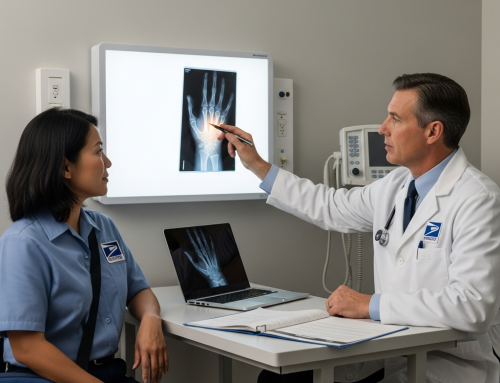
How DOL Doctors Communicate With OWCP Nurse Case Managers

Picture this: you’ve just left your doctor’s appointment feeling cautiously optimistic. Your physician seems to understand your injury, has a clear treatment plan in mind, and you’re finally starting to feel like someone’s in your corner. Then your phone rings. It’s a nurse case manager from OWCP, and suddenly the whole dynamic shifts. Your doctor gets pulled into phone calls you don’t know about, paperwork you never see, and conversations that – whether you realize it or not – can shape the entire direction of your claim.
That scenario plays out every single day for federal workers navigating the Department of Labor’s workers’ compensation system. And most of them have no idea how it actually works behind the scenes.
Here’s the thing nobody really explains to injured workers: the communication happening between your treating physician and your OWCP nurse case manager isn’t just administrative small talk. It’s not two professionals comparing calendars. That back-and-forth directly influences your treatment approvals, your return-to-work timeline, and honestly? Whether your claim moves forward smoothly or gets stuck in that particular brand of bureaucratic quicksand that OWCP is, unfortunately, sometimes known for.
Why This Matters More Than You Think
If you’re a federal employee with an active OWCP claim, you might assume that your doctor is your advocate, full stop. And in many ways, that’s true – your physician’s medical opinion carries real weight. But your doctor is also operating within a system that has its own language, its own paperwork requirements, and its own cast of characters. The nurse case manager assigned to your case is one of those characters, and understanding their role – and how they interact with your doctor – can genuinely change how you approach your own claim.
Some of these interactions are completely routine and helpful. A good nurse case manager can actually streamline communication, help your doctor understand OWCP’s specific documentation requirements, and move things along faster than they’d go otherwise. We’re not here to tell you that every NCM is an obstacle. That wouldn’t be fair or accurate.
But… and this is important… the relationship isn’t always straightforward. There are boundaries, conflicts of interest, and procedural details that every claimant deserves to understand. Because when you’re the one waiting on a treatment approval or wondering why your surgeon’s recommendation got kicked back, “I didn’t know how this worked” is a frustrating place to be.
What You’re Going to Learn Here
This article is going to walk you through the actual mechanics of how DOL doctors – meaning physicians treating patients under the OWCP system – communicate with nurse case managers. We’re talking about the different types of contact that happen (some of which you have the right to be present for, by the way), the documentation involved, and the ways these conversations can influence your care.
Actually, that last point is one most people overlook entirely. Your doctor might be recommending one course of treatment while an NCM is quietly suggesting alternatives based on cost or OWCP guidelines. Understanding when that’s appropriate and when it crosses a line? That’s genuinely useful knowledge.
We’ll also get into your rights as the injured worker – because you have more say in this process than you might think. Things like attending medical appointments when an NCM is present, requesting information about what’s being communicated on your behalf, and knowing when to flag concerns to your claims examiner. These aren’t complicated power moves. They’re just informed participation in your own care.
The federal workers’ compensation system can feel like a maze designed by someone who really loves paperwork and really dislikes clear signage. That’s just the honest truth of it. But the more you understand about how the pieces fit together – especially the physician-NCM communication piece that so rarely gets explained in plain language – the better positioned you are to advocate for yourself.
So whether you’re brand new to all of this, or you’re deep in an existing claim and something about the process has been nagging at you, stick with us. There’s a lot to unpack, and we’re going to do it in a way that actually makes sense.
You deserve to understand the system you’re working within. Let’s get into it.
The Players You Need to Know
Before any of this makes sense, you need a quick rundown of who’s actually in the room – or on the phone, as it usually goes. The Department of Labor (DOL) oversees the Office of Workers’ Compensation Programs, which is the federal agency that manages compensation and medical benefits for federal employees who’ve been hurt on the job. Think of OWCP as the insurance company in this scenario, except instead of Flo from Progressive, you’ve got a federal bureaucracy with its own very specific rules, forms, and vocabulary.
Your treating physician – the doctor managing your care – is one key player. The Nurse Case Manager (NCM) is another. And understanding what an NCM actually *does* is where a lot of injured workers get confused, honestly.
So What Does a Nurse Case Manager Actually Do?
Here’s the thing people often misunderstand: the NCM isn’t your nurse. They’re not there to take your temperature or hold your hand. They’re a registered nurse, usually hired through a third-party vendor contracted by OWCP, whose job is essentially to coordinate and monitor your medical care from the program’s perspective.
Think of them like a project manager on a construction site. They’re not swinging hammers – they’re making sure the right workers show up, the timeline is on track, and nothing goes wildly over budget. In your case, the “project” is your recovery and return to work.
NCMs review medical records, communicate directly with your treating physician, attend appointments (sometimes in person, sometimes by phone), and write reports back to OWCP summarizing your progress. That last part is worth sitting with for a moment. They are reporting back to the agency that controls your benefits. That’s not sinister necessarily, but it’s something you should understand clearly.
How Doctors Actually Communicate With NCMs
This is where it gets a little… layered. The communication happens through several channels, and each one carries different weight.
The most formal channel is written documentation – office notes, treatment plans, work capacity forms like the CA-17, and written responses to specific questions the NCM submits. These documents become part of your official OWCP file, which means they matter enormously. A doctor’s casual verbal comment can be walked back. A written note in your file? That sticks around.
Then there’s direct contact – phone calls, emails, or in-person meetings at appointments. This is where things get genuinely nuanced, and frankly, a little counterintuitive. An NCM has the right to communicate with your doctor, but you have rights around that communication too. Under OWCP guidelines, you can request that all NCM contact with your physician happen in your presence, or at least with your knowledge. A lot of injured workers don’t realize this.
The CA-17 – The Form That Drives Everything
If there’s one piece of paper that controls the rhythm of this whole communication process, it’s the CA-17, officially titled “Duty Status Report.” Your doctor fills this out to tell OWCP what you can and can’t do physically – whether you’re totally disabled, whether you can work with restrictions, what those restrictions are, and how long the current status is expected to last.
The NCM essentially works around this form. They’ll often follow up with physicians when a CA-17 is vague, when the timeline seems longer than expected, or when there’s a question about whether your work restrictions match the available light-duty positions your employer might be offering. That follow-up is where a lot of the real communication – and real tension – happens.
Why “Coordination” Can Feel Like Something Else Entirely
Here’s something worth saying plainly: even though NCMs are presented as care coordinators, many injured workers experience their involvement as… adversarial. Or at least, uncomfortable. That’s not automatically because anyone is acting in bad faith – it’s often just the structural reality of the situation. Someone whose job involves monitoring your claim and reporting to the agency managing your benefits is occupying a strange dual role, no matter how professional they are.
Your doctor may not always appreciate that tension either. Physicians who regularly treat federal workers generally learn to navigate NCM communication carefully – knowing what to document, what to say verbally, and when to push back. Those who are newer to OWCP cases sometimes find the whole system genuinely baffling. Which, honestly, is a fair reaction.
Treat Every Nurse Case Manager Interaction Like It’s on the Record
Here’s something a lot of injured federal workers don’t realize: the conversations your DOL doctor has with the OWCP nurse case manager (NCM) aren’t just casual check-ins. They’re shaping your case narrative in real time. Everything discussed – your work capacity, your treatment progress, your functional limitations – can end up in a report that influences your claim. So the first practical tip is simple: ask your doctor to document every NCM contact in your medical record. Date, time, what was discussed, and what was agreed upon. No exceptions.
If your doctor’s office is treating NCM calls like routine administrative noise, that’s a problem you’ll want to address directly.
Coach Your Doctor Before the NCM Gets in the Room
This one surprises people. You actually have the right – and honestly, the responsibility – to prepare your treating physician before any NCM meeting or call happens. Schedule a few extra minutes at your next appointment specifically to talk about this. Bring a written summary of your functional limitations, the activities you genuinely can’t do without pain or risk, and any restrictions that affect your work duties.
Why does this matter? Because NCMs sometimes ask questions in ways that can lead a well-meaning doctor to understate your limitations. “Could this patient do light desk work?” sounds reasonable in conversation. Your doctor might say “possibly” – not thinking about what that answer looks like in a formal report. Specificity from your doctor is your best protection. Push for restrictions described in concrete terms: no lifting over 10 pounds, no prolonged sitting beyond 20 minutes, no repetitive use of the right hand. Vague language like “limited duty” leaves too much open to interpretation.
Request Written Copies of NCM Reports (You’re Entitled to Them)
This is the tip most people miss entirely. NCMs are required to send copies of their reports to you – the claimant – as well as to your employer and OWCP. If you’re not receiving these, something has gone sideways in the process. Contact your OWCP claims examiner and request copies directly.
Once you have them, read carefully. Look for anything that misrepresents what your doctor said, minimizes your restrictions, or introduces language about your ability to return to work that your physician never actually endorsed. Errors in these reports can be disputed – but only if you catch them quickly. Waiting months to raise a discrepancy makes it much harder to correct the record.
Know the Difference Between a Nurse Case Manager and Your Ally
Actually, this is worth saying plainly: the NCM is not your advocate. They’re employed by OWCP or a contracted vendor, and their role – while framed as “coordination” – ultimately serves the program’s interest in managing costs and return-to-work timelines. That doesn’t mean every NCM is adversarial… but it does mean you shouldn’t confuse professional friendliness with someone being in your corner.
Your doctor should feel comfortable with you present during any in-person NCM meetings. If an NCM pushes back against your treating physician’s restrictions or suggests alternative light-duty options, your doctor is not obligated to change their clinical opinion on the spot. A good doctor will say “I’ll review that and follow up in writing.” That’s the move. Verbal pressure during a meeting shouldn’t override documented medical judgment.
Keep a Simple Communication Log Yourself
Grab a notebook – seriously, a plain paper notebook works fine – and log every single interaction related to your case. When your doctor’s office says the NCM called, write it down. When you receive an NCM report, log it. When your doctor updates your work restrictions, note what changed and why.
This log becomes quietly powerful if your case ever gets complicated or disputed. You’ll have a timeline that nobody else has. You can cross-reference your doctor’s chart notes against NCM reports and spot inconsistencies. It takes maybe five minutes after each interaction, but it’s the kind of thing that makes your case far easier to manage – and far harder to misrepresent.
Your treatment is supposed to be driving this process. Not administrative pressure, not return-to-work timelines from a nurse you’ve never met. Staying engaged, staying documented, and keeping your physician well-informed is how you make sure it stays that way.
When Communication Goes Sideways (And It Does)
Let’s be honest – this whole system isn’t exactly a well-oiled machine. Federal workers navigating OWCP claims often find themselves caught in the middle of a communication breakdown that nobody planned but everybody experiences. Your doctor is busy. The nurse case manager has a caseload that would make your eyes water. And somewhere in the middle? Your care.
Here’s what actually trips people up.
The Documentation Gap Nobody Warned You About
One of the most common – and honestly most frustrating – problems is when a treating physician documents your condition thoroughly in their own notes but doesn’t translate that into OWCP-specific language. These are two completely different things. A chart note that says “patient reports ongoing pain limiting daily function” is clinically appropriate but practically useless for OWCP purposes.
Nurse case managers need to see work-related causation connected explicitly to your accepted condition. They need functional limitations spelled out in concrete terms – not “limited mobility” but “unable to stand for more than 15 minutes without significant pain.” The gap between good clinical documentation and good OWCP documentation is real, and most physicians didn’t go to medical school to learn federal workers’ comp paperwork requirements.
The solution: Ask your doctor directly – not in a confrontational way, but genuinely – whether they’re familiar with OWCP documentation standards. If they’re not, some clinics that specialize in federal employee care actually provide their physicians with OWCP-specific charting templates. It’s worth asking.
The Nurse Case Manager Attendance Question
This one comes up constantly. Nurse case managers have the right to attend your medical appointments – and that makes a lot of patients uncomfortable, understandably so. The dynamic can feel off. Is she there to help you? To report on you? Both, kind of, which is the awkward truth.
Some physicians handle this well. Others don’t push back when an NCM starts steering the conversation in ways that don’t serve the patient’s best interest. And some patients don’t realize they can ask the NCM to wait outside during the private portion of the exam.
You have that right. Use it if you need to. Your doctor should be hearing *your* account of your symptoms first, without a third party in the room shaping the narrative before you’ve opened your mouth.
When Response Times Stall Everything
Here’s something nobody tells you upfront – delays in communication between your doctor and the NCM can directly affect your treatment approvals. If your physician’s office doesn’t respond to NCM requests within a reasonable window, the nurse may document that as non-cooperation. That can cascade into authorization delays for procedures, medications, physical therapy… the works.
The problem is usually not malice – it’s that your doctor’s front desk staff may have no idea what OWCP is, why the NCM keeps calling, or who should actually be responding. Medical offices handle hundreds of calls. OWCP paperwork tends to fall through cracks.
The solution here is unsexy but effective: Designate one person in your physician’s office as the OWCP contact. If you’re a patient dealing with this, you can actually help make this happen by asking your doctor to loop in their office manager. A direct fax line for OWCP correspondence – separate from general medical records requests – makes an enormous difference.
Disagreements Between Your Doctor and the NCM
This is where things get genuinely complicated. Sometimes your treating physician recommends something – a specialist referral, a particular treatment, a work restriction – and the nurse case manager pushes back. Maybe she’s communicated with a second-opinion physician hired by OWCP. Maybe the insurer’s medical guidelines don’t align with what your doctor thinks is clinically appropriate.
Your doctor isn’t obligated to agree with the NCM. But they do need to document their clinical reasoning clearly and specifically. “Medically necessary” isn’t enough. Why is it necessary? What happens if it’s not approved? What does the literature say?
Actually, that reminds me of something worth emphasizing – physicians who take the time to write a strong letter of medical necessity, with specific references to your accepted condition and functional limitations, win these disagreements far more often than those who submit a checkbox form and hope for the best.
The Bigger Picture
None of these challenges are insurmountable. But they do require something most of us aren’t naturally great at – proactive communication before problems escalate. The patients and physicians who navigate OWCP successfully tend to treat the process like a collaboration rather than an obstacle course, which… fair enough, is easier said than done when you’re dealing with a work injury and just want to feel better.
What to Actually Expect (And When to Worry)
Let’s be honest with you here – the federal workers’ comp process moves slowly. Like, *really* slowly. If you’re coming from a world where things get resolved in days or weeks, the OWCP timeline is going to test your patience in ways you probably haven’t anticipated. That’s not pessimism. That’s just the reality of navigating a system with a lot of moving parts, multiple agencies, and a whole lot of paperwork.
So what does “normal” actually look like?
After your DOL doctor and the nurse case manager (NCM) have their initial contact – whether that’s a chart review, a phone call, or an in-person case conference – you’re typically looking at several weeks before you see any meaningful movement on decisions like treatment authorizations or work capacity determinations. Sometimes longer. A month isn’t unusual. Two months isn’t cause for alarm. It feels endless when you’re the one waiting, we know that.
The Communication Loop (And Where You Fit In)
Here’s something that trips a lot of injured workers up: most of the communication between your treating physician and the NCM happens *without you in the room*. That’s legal, and it’s normal, but it can feel unsettling – like people are making decisions about your body and your livelihood and you’re not even part of the conversation.
You do have rights here, though. You can request copies of any written communication. You can ask your doctor what was discussed after a case conference. And honestly? You should. Don’t just sit back and assume everything is being handled the way you’d want it handled. Ask questions. Write things down. Be the squeaky wheel – politely, but consistently.
Your union rep or attorney (if you have one) can also help you track what’s happening and flag anything that seems off.
Milestones to Watch For
It helps to have mental checkpoints so you know when something has actually moved forward versus when things are just… sitting. Here’s a rough framework
– Initial NCM assignment – usually happens within the first few weeks after your claim is accepted – First contact between NCM and your doctor – could be weeks after that, depending on caseloads – Treatment authorization decisions – these can take 30-60 days or more, even for straightforward requests – Work capacity evaluations – if your doctor and NCM disagree on your ability to return to work, expect additional back-and-forth that stretches the timeline further
None of these are guarantees. OWCP cases vary enormously depending on the nature of the injury, your specific district office, and frankly, individual caseloads. Some people move through the system faster. Some hit inexplicable delays that make no sense from the outside.
When Something Actually Needs Your Attention
There’s a difference between “this is taking forever” (normal, frustrating, but okay) and “something is actually wrong here” (needs action). Watch for these red flags
If your doctor mentions they’ve received communication from the NCM that seems to be pushing toward case closure or a return-to-work recommendation that doesn’t match your actual medical situation – pay attention to that. NCMs are supposed to facilitate care, not steer outcomes. It doesn’t always work that way in practice.
If you’re not receiving Notices of Accepted Decision or you’re getting unexpected denials, that’s the moment to loop in someone who knows OWCP claims law. A workers’ comp attorney who specializes in federal cases can be genuinely worth their fee at that point.
And if your treating physician seems uncertain about what they can or can’t communicate to the NCM – that’s worth a conversation. Some doctors, especially those newer to the DOL system, don’t fully understand the boundaries of these interactions.
Setting Yourself Up Going Forward
The most useful thing you can do right now is get organized. Keep a running log of every phone call, every document received, every appointment. It sounds tedious – and it is – but that paper trail becomes invaluable if something gets disputed later.
Stay in close contact with your doctor. Make sure they understand your work situation, your functional limitations, and what you actually need from them when they’re communicating with the NCM. They’re your advocate in this process, but they can only advocate well if they have the full picture.
The system is imperfect. The timelines are frustrating. But understanding how these communications work – and what’s normal versus what’s not – puts you in a much stronger position than most people navigating this process on their own.
Working through the federal workers’ comp system can feel genuinely overwhelming – and honestly, that feeling makes complete sense. You’re managing a real injury, real pain, and real paperwork all at once, while trying to figure out who’s talking to whom and whether anyone is actually advocating for *you* in those conversations.
Here’s what we want you to hold onto: communication between your treating physician and the nurse case manager assigned to your case doesn’t have to be a black box. When it’s working well – when your doctor is informed, proactive, and documenting everything carefully – those conversations actually move your care forward. They can speed up authorizations, clarify treatment plans, and keep your case from getting stuck in bureaucratic limbo. It really does matter who’s in your corner.
That said, the system isn’t always intuitive. Some doctors who are wonderful clinicians haven’t worked extensively with OWCP protocols, and that learning curve can slow things down in ways that have nothing to do with how serious your injury is. Nurse case managers vary too – some are genuinely helpful coordinators, others can feel more like gatekeepers. Knowing the difference, and knowing your rights within that dynamic, is half the battle.
You Don’t Have to Navigate This Alone
If there’s one thing worth repeating, it’s that. Whether you’re just starting a claim, feeling stuck in the middle of one, or trying to make sense of why a treatment got denied – these aren’t questions you should have to puzzle through by yourself at midnight with a stack of OWCP forms on the table.
A good medical provider who understands the DOL system can make an enormous difference. Not just in terms of treatment – though obviously that matters most – but in terms of how your case is documented, communicated, and ultimately resolved. The right physician knows how to speak the language that OWCP needs to hear, and knows how to engage with nurse case managers in a way that keeps your care moving instead of stalling.
Actually, that’s exactly why we do what we do.
We’re Here When You’re Ready
If you’re a federal employee dealing with a work-related injury and you’re feeling lost in the process, we’d genuinely love to talk with you. No pressure, no confusing intake paperwork to decipher on your own – just a real conversation about where you are and how we might be able to help.
Our clinic works regularly with OWCP cases. We understand the documentation requirements, the authorization process, and yes – how to communicate clearly and effectively with nurse case managers in a way that keeps your treatment, and your claim, on track.
You’ve already been through enough. The last thing you need is to feel like you’re fighting the system on top of everything else.
Reach out to us whenever you’re ready – whether that’s today or after you’ve had time to think it over. You can call our office, send a message through our website, or just stop in. We’re not going anywhere.
You deserve care that actually advocates for you. And we’d be honored to be part of that.